
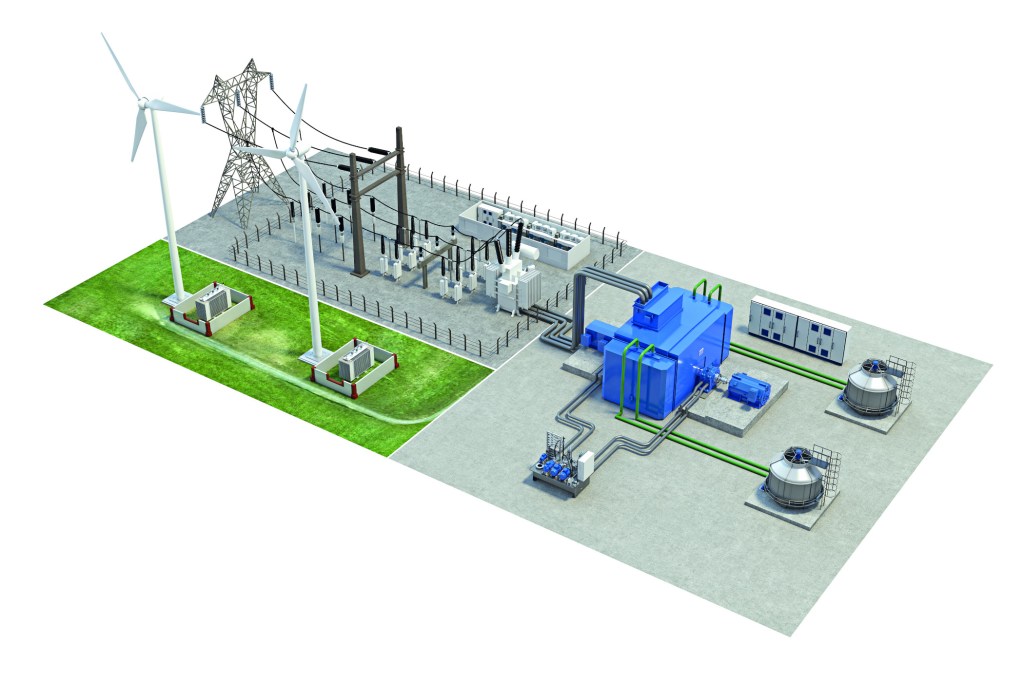
~ WEG’s rotating synchronous condensers support power system reliability ~
The growth of wind and solar power has accelerated. However, renewables pose challenges with voltage fluctuations that can cause equipment wear, inefficiencies and potential blackouts. To maintain power stability, energy providers must adopt advanced technologies. Here, Mark Newman, business development manager – end user at WEG high voltage solutions EU and Middle East, explains how WEG’s rotating synchronous condensers contribute to stabilising renewable energy sources and optimising power flow in the grid.
According to Deloitte’s 2025 Renewable Energy Industry Outlook, demand for clean energy is now outpacing supply. This trend places additional strain on power systems as more variable sources like wind and solar are integrated into the grid, presenting several management challenges.
Renewable energy sources are more difficult to manage than conventional sources for several reasons. First, they are less predictable — solar panels, for example, generate power intermittently depending on sunlight. Second, renewable energy is increasingly decentralised, with rooftop solar panels and battery storage spread across wider geographical areas. Third, high penetrations of distributed renewables in low‑ and medium‑voltage networks can lead to increased voltage variability and altered loss profiles, creating new operational challenges for network operators.” instead.
A key challenge within these fluctuations is balancing real power with reactive power. Real power, measured in watts (W), performs useful work — powering electrical devices. Reactive power, measured in volt-amperes reactive (VAr), does not perform useful work but is essential for maintaining voltage stability in alternating current (AC) systems. Ensuring an optimal balance between these two types of power is crucial for grid efficiency.
Traditional reactive power compensation devices, such as capacitor banks, static VAr compensators and transformer tap changers, have been used for this purpose. However, these devices often lack real-time responsiveness and frequent switching can cause equipment wear, reducing reliability.
Innovations in voltage regulation
As the grid evolves, energy suppliers must adopt more adaptable and efficient technologies to manage real and reactive power. These solutions must also comply with grid codes, technical standards set by national or regional energy regulators to ensure the stable, safe and efficient operation of electricity grids — especially as new energy sources are added.
Among the most effective solutions are rotating synchronous condensers, which generate or absorb reactive power as needed in order to stabilise voltage levels. Unlike traditional devices, synchronous condensers provide continuous, real-time voltage regulation without the need for frequent switching. They enhance grid stability by responding instantly to voltage fluctuations and help ensure adherence to stringent grid codes.
Furthermore, synchronous condensers do not introduce harmonics or resonance into the system, making them a preferable alternative to conventional reactive power compensation methods.
Real-world applications
Let’s look at some examples of how rotating synchronous condenser systems have proven effective in practical settings. In Brazil, energy provider Eletrosul has implemented WEG’s synchronous condensers to strengthen its transmission network.
WEG’s Rotating Synchronous Condenser is engineered for performance and reliability. By either generating or absorbing reactive power, it keeps voltage within safe operating limits, ensuring efficient transmission of electricity, particularly in areas with high renewable energy penetration.
The system can adjust power flow to stabilise voltage, handling up to ±330 megavolt-ampere reactive (MVAr), based on regional voltage and frequency standards. These values mean the system can ensure precise voltage control.
For Eletrosul, two synchronous condensers were supplied, each capable of generating or absorbing ±100 MVAr at 15,000 volts (V). These units dynamically adjust reactive power to stabilise voltage fluctuations, ensuring a steady flow of electricity across long-distance transmission lines. The placement of these condensers helps balance energy distribution, reducing the risk of disruptions in urban and industrial centres and significantly enhancing the reliability of the country’s power grid.
Meanwhile, in the United States, Southern Power has incorporated WEG’s synchronous condensers into its wind energy operations. These units, with a capacity of -25/+25 MVAr at 13,800 V, help regulate voltage levels in areas where wind power production can vary frequently. The ability of these condensers to respond instantly to fluctuations in generation prevents voltage drops, improving overall grid stability and reducing the likelihood of disruptions. These installations highlight how synchronous condensers are increasingly used to maintain voltage stability and system strength in networks with high and variable renewable penetration.
Compatibility with existing infrastructure
At the core of the performance of WEG’s Rotating Synchronous Condenser is a stator built using low-loss silicon steel lamination, which minimises energy dissipation as heat for enhanced overall efficiency, lowering power consumption and cooling requirements. The system also includes sleeve bearings with an external forced oil lubrication system to reduce wear and extend service life.
The system features a high-pressure lifting mechanism for smooth startup and shutdown, reducing stress. A variable frequency drive (VFD) induction pony motor — a smaller auxiliary motor used to drive a larger motor or system — accelerates the synchronous condenser to speed, minimising impact on the grid. It operates efficiently in various conditions with advanced cooling options and a condenser rated IP23 to IP55 for dust and moisture protection, while multiple mounting configurations ensure easy installation and compatibility with existing power infrastructure.
As clean energy adoption accelerates, the demand for renewable energy is outpacing supply, creating a resource gap that threatens grid stability. Deloitte’s 2025 Renewable Energy Industry Outlook emphasises the urgent need to reinforce power networks to meet this challenge. In response, WEG’s Rotating Synchronous Condenser provides a reliable, efficient solution to mitigate voltage fluctuations, integrate renewables and ensure a stable, resilient grid. Additionally, WEG’s Battery Energy Storage System (BESS) further enhances grid flexibility by storing excess renewable energy and supporting peak demand periods.
 WEG Europe and Middle East