
As global demand for oil and gas continues to rise — particularly across the Middle East — operators face mounting pressure to ensure stable operation under some of the harshest climatic conditions on the planet. Against this backdrop, WEG, a global manufacturer of motors, and D’Hondt Thermal Solutions (DHTS), a French specialist in industrial cooling, have joined forces to deliver a new generation of high-efficiency air-cooling solutions that help safeguard continuous operation, reduce energy consumption and extend plant asset life.
In energy-intensive industries, where thermal balance determines both productivity and safety, the reliability of cooling systems is a fundamental requirement rather than an optional enhancement. Across major sites in the Middle East, thermal management and mechanical reliability are not only performance criteria, they are essential for operational continuity.
Operators also face new constraints such as reducing water consumption, lowering energy use and extending the life of installed assets, all while complying with increasingly demanding environmental regulations. Air-cooling systems — which operate without water or refrigerant fluids — have consequently gained strategic importance in arid regions, becoming a key element of long-term energy planning by minimising resource use, supporting reliable operation and extending equipment lifespan.
A large-scale project at the heart of the Middle East
To address these requirements, WEG and DHTS combined their expertise to equip a major energy complex with high-efficiency industrial air coolers. A partnership built on innovation, precision and long-term vision.
This strategic project is part of a global framework agreement between WEG and DHTS. Its goal is to equip the oil and gas site with a complete air-cooling system designed for continuous operation under extreme climatic conditions including heat, dust and salty air. In such environments, every component must be engineered to last.
DHTS, a French company founded over 70 years ago, has established itself as a global leader in industrial cooling. Its air-cooler solutions, used across major international energy sites, ensure thermal regulation of critical processes in oil, gas and petrochemicals.
With operations in France, Saudi Arabia and South Korea, DHTS designs and manufactures systems capable of continuous operation. This international presence ensures close operational proximity to key players in the energy sector and precise adaptation to local realities. Its air-cooling technology requires neither water nor refrigerant fluids, a strategic choice in arid regions where resource efficiency is a key industrial priority.
Powering energy with reliable motor technology
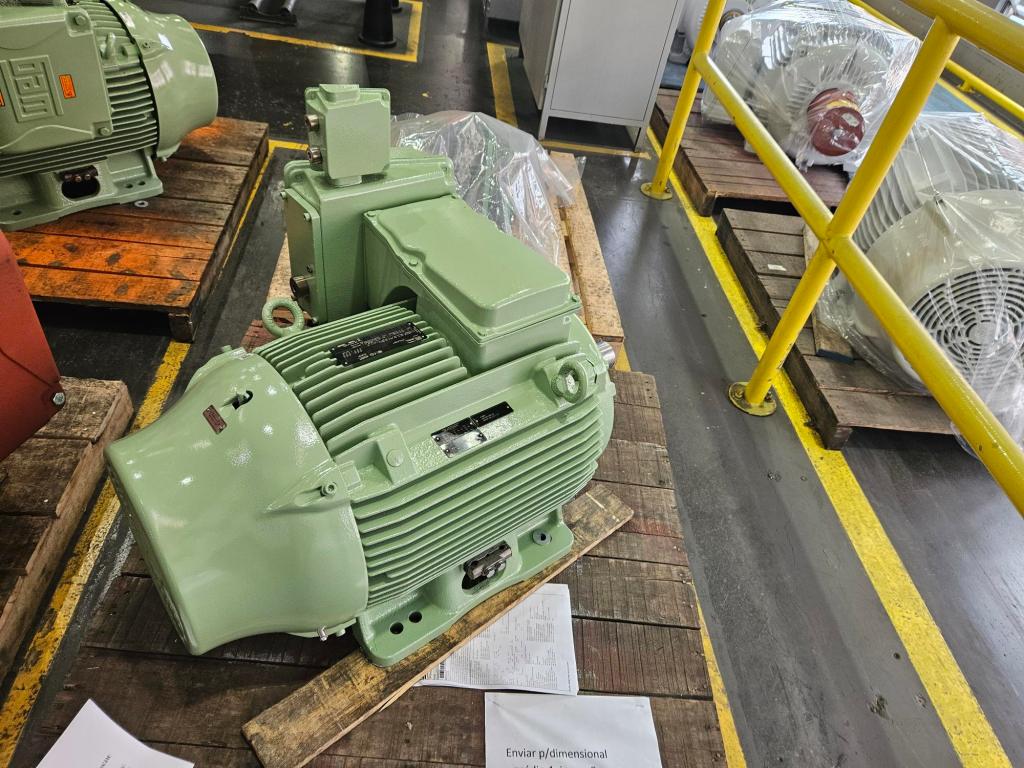
To ensure the airflow required for cooler operation, WEG supplied all the motors and variable-speed drives for the project. Deliveries began in early 2024 and will continue until the end of 2026. The equipment includes 496 W22 motors, mainly 37 and 45 kilowatt (kW) models.
The W22 motors are engineered for harsh environments. Their design, built on decades of industrial experience, combines mechanical robustness, high protection ratings, IE3/IE4 energy efficiency, low vibration and ease of maintenance. The ventilation system design of this line provides lower noise levels and allows a better distribution of the air flow over the motor, which minimises hot spots on the surface and increases reliability.
These are complemented by four high-power 110 kW, 12-pole units as well as four AFW900 control panels used for system regulation. Equipped with the built-in CFW900 frequency inverter, the setup delivers high performance and safety while offering flexibility and connectivity. The combination of standardised models, multiple options and on-demand customisations provides a practical, ready-to-install solution suitable for a wide range of applications.
Each component, from motor to drive, is built to operate continuously with minimal human intervention. In the field, this robustness translates into fewer unplanned shutdowns, reduced electrical consumption and improved operational stability.
In critical infrastructures such as this, the ability to integrate motors with advanced variable-speed drives adds a second layer of performance optimisation. By adjusting fan rotation precisely to process needs, the system avoids unnecessary energy expenditure and reduces mechanical stress. Over the lifecycle of an oil and gas facility, this variable-speed capability can represent thousands of hours of additional uptime and substantial reductions in operational cost.
A collaboration built on trust and precision
The cooperation between WEG and DHTS is rooted in a long-term relationship. Engineers from both companies worked hand in hand through calculations, testing, validation and production follow-up. This constant dialogue, from design to commissioning, ensures consistency and reliability of the entire system. The global framework agreement formalises this approach by establishing a long-lasting partnership based on technical complementarity and transparency.
This project also benefits from a strong logistical and technical support network. Local teams in the Middle East ensure rapid delivery coordination, installation guidance and onsite troubleshooting if needed. For operators, this proximity is essential when managing mission-critical assets where downtime must remain close to zero. It is this rigorous approach that enables both companies to deliver equipment capable of operating 24/7, year after year, without compromising safety.
As the oil and gas industry evolves, operators must balance growing output demands with the need to reduce resource consumption and ensure uninterrupted service. By delivering systems built for extreme durability, low energy use and precise control, the two companies contribute not only to operational excellence but also to more sustainable industrial practices.
For more information about WEG’s motors and drives, visit its website.
 WEG Europe and Middle East