
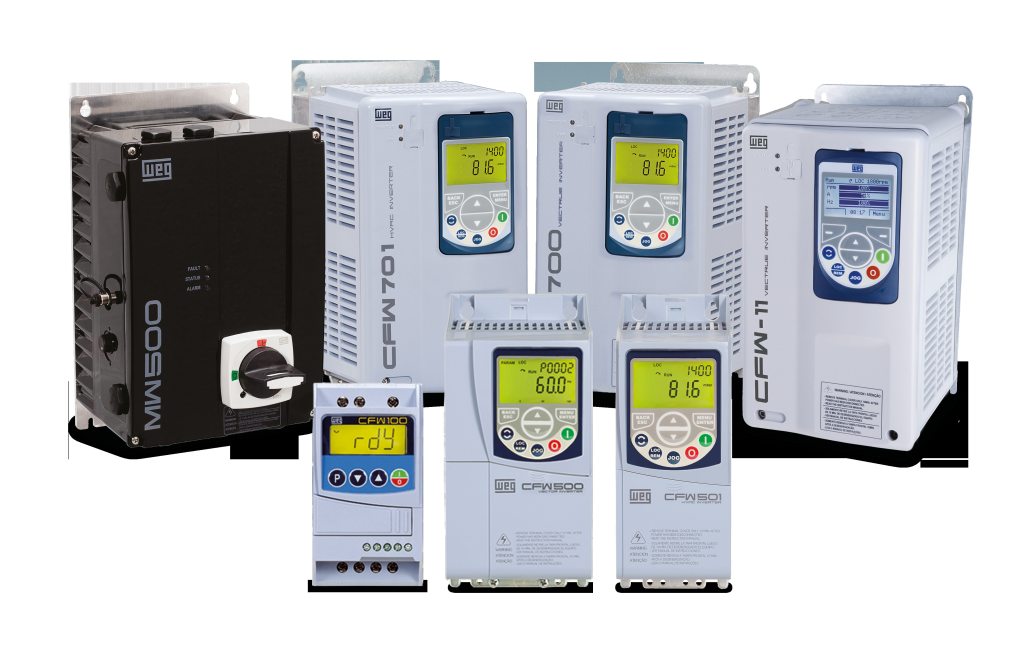
New ecodesign requirements for electric motors and variable speed drives (VSDs).
France has the third largest economy in Europe, led by its thriving tourism, manufacturing and energy sectors. So, what effect will the new European legislation 2019/1781 have on the French market? Here, Yves Jamet, marketing manager at WEG France SAS, a leading global manufacturer of motors and drives, explains how the new ecodesign requirements for electric motors and variable speed drives (VSDs) will impact French industry.
The European Commission has set out its roadmap to reduce net CO2 emissions by 2050 and become a climate neutral continent. Rapid implementation of energy-efficient and renewable energy legislation is needed to reach these goals. While we await the first European Climate Law, the European Commission has already set out new ecodesign requirements that will apply to electric motors and drives.
With approximately 63 per cent of the electrical consumption absorbed by electric motors, new European regulation 2019/1781, sets out ecodesign requirements for electric motors and Variable Speed Drives (VSDs). The changes will apply from 1 July 2021 and will change the French supply chain of electric motors considerably. Most news-worthy is the inclusion of hazardous area or ATEX motors to the regulation — a group of motors that were once exempt from such standards. Additionally, the regulation will also be imposed on VSDs for the first time.
The new regulations will replace the regulation EC 640/2009 currently in force and could bring huge improvements to the energy consumption related to motor use, while maintaining the required level of safety.
What are the requirements?
The EU MEPS (European Minimum Energy Performance Standard) indicates how energy efficient a motor or drive is. IE1 describes standard efficiency, IE2 is high efficiency and IE3 is used for motors with premium levels of efficiency. These performance standards aren’t however consistent across the motor and VSD range. For example, the requirements for IE2 in a motor are not the same as an IE2 VSD. From July 1, 2021, lower efficiency products will no longer be accepted, as a wider range of motors are brought into scope and held to higher standards. This applies to products placed onto the market or put into service after these dates.
The current regulation on ecodesign for electric motors applies to single speed, three-phase 50Hz or 50/60Hz, induction motors with two to six poles with output between 0.75kW and 375kW and rated voltage up to 1000V (highlighted in red on the table). Under the new regulation, smaller induction motors between 120W and 750W and larger motors between 375kW and 1000kW will also be included. Three phase eight pole motors, single-phase motors, ATEX and Ex eb motors will also fall under these requirements for the first time. The new ecodesign rules are compulsory for all manufacturers and suppliers of these electric motors, selling their components in France and the rest of the EU. All non-compliant products will be banned from sale, so it’s important for motor manufacturers to know the requirements.
Minimum Efficiency of Electric Motors and Variable Speed Drives
The table above shows the proposed scope, corresponding ambition levels and timeline, the part in red corresponding to the current measure.
(*) Ambition not actually covered in the regulation text
How will this impact industry?
The legislative changes will impact many industries, but sectors with high energy usage or employing hazardous area motors may see the most transformation. Germany and France are the two largest chemical producers in Europe, therefore it’s no surprise, that the French organisation INSEE, reported that the chemical sector was the second most energy-consuming industrial sector in France, after the steel industry.
In 2015, the French chemical industry accounted for 1.667 million TOE (Ton of Oil Equivalent) of electricity consumption in the country. The new regulation, which will impose new minimum efficiency requirements for ATEX Motors, could lead to very significant energy savings in the chemical sector.
The food industry will also be impacted, as there are many applications using hazardous area motors where there are high levels of combustible materials such as flour or dust residues. In France, the food industry is the third largest electricity consuming industry.
As a result of safety requirements, explosion proof motors (Ex db, Ex dc) may face design constraints such as an increased airgap, reduced starting current and enhanced sealing. This may sometimes result in a larger frame size, which could lead to additional considerations when retrofitting equipment with a need for motor interchangeability.
Significant improvement to motor design can be achieved, without incurring substantially extra costs. However, the use of high energy class IE motors and speed variation must not replace a fundamental rule: the electric motor must be properly dimensioned according to its real load. If a motor is oversized, with the actual load less than 70 per cent of the rated load, it will have degraded efficiency and power factor values.
It is predicted that the legislation will offer multiple benefits for Europe by 2030, including energy and cost savings. Specifically, extra energy savings of 10 TWh/yr and GHG emission reduction of 3 Mt CO2 equivalent annually, as well as extra savings on annual end user expenditure of EUR 1.3 billion and additional business revenue of EUR 0.3 billion per year.
Thanks to significant investments in research and development WEG anticipated this change in regulation. Its ATEX explosion proof motor ranges are now available in IE2 and IE3 in the IEC dimensional standard. WEG also has a super-premium range of safe area and hazardous area IE4 motors. This will prove useful as from 2023, safe area motors between 75kW and 200kW that are not brake motors or hazardous area motors, will be required to meet efficiency class IE4.
The W22 IE3 (safe zone) and W22Xd IE3 (explosion proof Exdb) motors for powers between 0.75 and 75 kW have already proven popular in the French market. If you need to upgrade your low energy efficient electric motor, get in touch with WEG today or visit the website to view the full product range.
 WEG Europe and Middle East